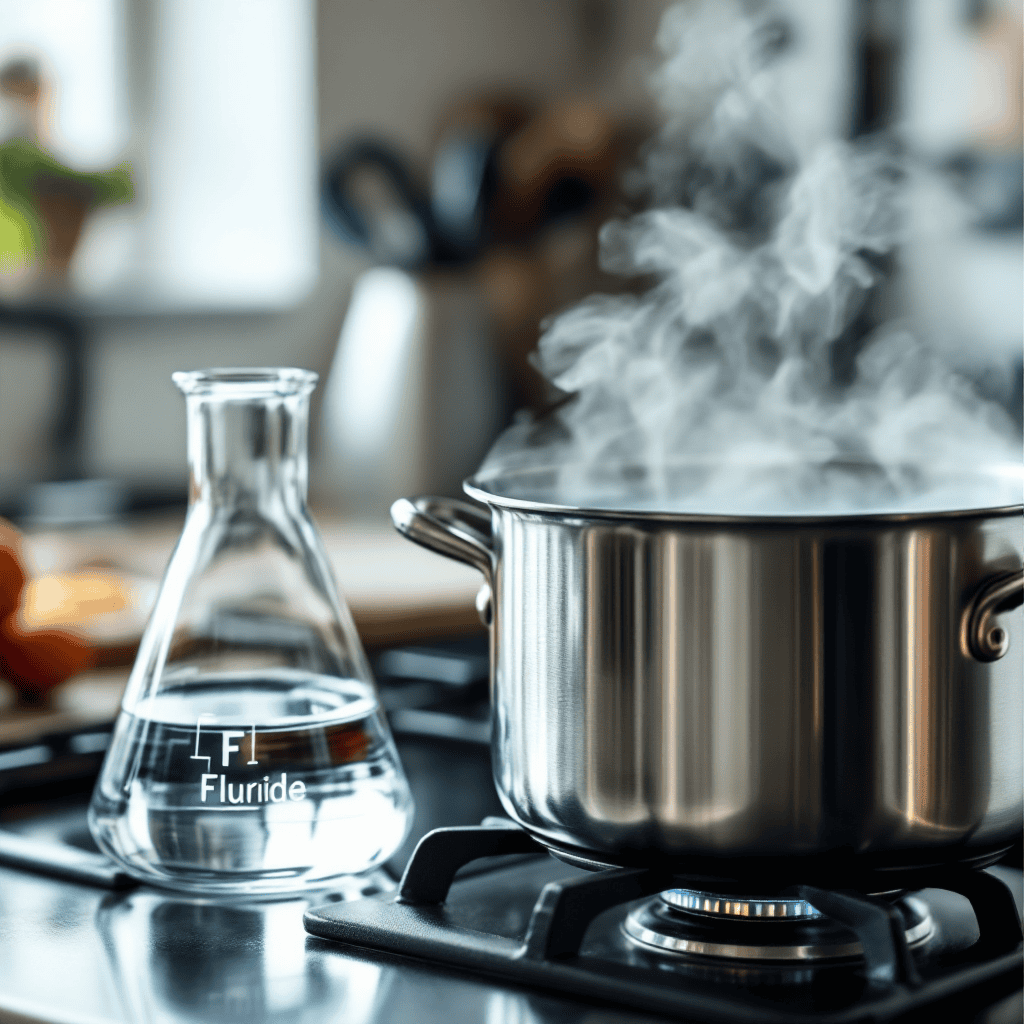
Does boiling water remove fluoride? No. Boiling water does not remove fluoride. In fact, it concentrates it. When you boil water, you evaporate pure H₂O, leaving dissolved minerals and contaminants behind in a smaller volume. Fluoride is a dissolved ion, not a volatile compound. It does not boil off. The longer you boil, the more concentrated the fluoride becomes. If you started with 1 ppm of fluoride in a liter of water and boiled away half the volume, you would end up with roughly 2 ppm in what remains. Boiling kills bacteria and removes some volatile organic compounds, but it makes the fluoride problem worse, not better.
This matters because fluoride is not a minor issue. It is one of the most effective tools for calcifying the pineal gland, the small endocrine organ deep in your brain that regulates your circadian rhythm, produces melatonin, and serves as what mystics across traditions have called the seat of inner perception. When the pineal calcifies, your body’s entire hormonal network destabilizes. Sleep disrupts. Mood flattens. The inner light dims. And the substance doing the damage is delivered directly through your tap, approved by public health agencies, and defended as safe and effective despite decades of peer-reviewed evidence showing otherwise.
Why Fluoride Was Added to Water in the First Place
The official story is simple. Water fluoridation began in 1945 as a public health measure to prevent tooth decay. What that narrative leaves out is where fluoride actually comes from. It is a toxic byproduct of aluminum refining and phosphate fertilizer manufacturing. Before fluoridation, disposing of this industrial waste cost money and carried liability. Reframing it from hazardous byproduct to public health additive solved two problems at once. It reduced corporate disposal costs and created a revenue stream from a substance that would otherwise require expensive remediation. Whether the architects of this policy acted with malice or convenience, the result is the same. The organ most responsible for inner perception gets calcified from the inside, and the population defends it as progress.
The pineal gland accumulates more fluoride than any other soft tissue in the body. Research by Dr. Jennifer Luke at the University of Surrey in the 1990s found that fluoride concentrations in the pineal exceed those in teeth and bone. The gland sits outside the blood-brain barrier and is one of the most highly vascularized organs in your body, making it uniquely vulnerable to circulating toxins. When fluoride accumulates, it interferes with the gland’s calcite crystals, disrupts melatonin production, and destabilizes the regulation of every downstream gland in your endocrine system. This is not fringe theory. It is documented endocrinology, published in peer-reviewed journals, and systematically ignored by the agencies tasked with protecting public health.
What Boiling Actually Does to Your Water
Boiling water is effective for certain purposes. It kills pathogens like bacteria, viruses, and parasites. It removes chlorine, which is volatile and evaporates as steam. It can drive off certain dissolved gases and some organic compounds. But fluoride is not any of those things. Fluoride is a stable, non-volatile ion. It stays in solution regardless of temperature. The only way boiling changes fluoride content is by reducing the total water volume, which increases the concentration of everything that does not evaporate. If your municipal water contains 0.7 parts per million of fluoride, a common level in fluoridated systems, and you boil that water down by 30 percent, you are left with roughly 1 ppm in the remaining liquid. You have not purified it. You have made it worse.
This same principle applies to other dissolved minerals. Calcium, magnesium, sodium, heavy metals, nitrates, and pharmaceutical residues all remain in the water after boiling. Some of these are beneficial in small amounts. Others are not. Boiling is a thermal process, not a filtration or chemical separation process. It addresses biological contamination and volatile compounds. It does nothing for dissolved solids. The widespread belief that boiling purifies water comes from conflating sterilization with purification. They are not the same thing. Sterilized water can still carry a full payload of fluoride, lead, arsenic, and glyphosate. Those require different methods entirely.
What Actually Removes Fluoride From Drinking Water
If boiling does not work, what does? The answer depends on the method and the level of investment you are willing to make. Not all filtration systems are created equal, and most of the common ones people rely on do not touch fluoride at all. Standard carbon filters, including Brita pitchers and most refrigerator filters, remove chlorine, improve taste, and catch some sediment. They do not remove fluoride. Ultraviolet sterilizers kill microorganisms but leave all dissolved minerals untouched. Boiling, as covered, concentrates fluoride rather than removing it. If you want fluoride out of your water, you need one of the following methods.
Reverse osmosis is the most effective and widely accessible option. An RO system forces water through a semipermeable membrane that blocks fluoride ions along with most other dissolved solids. A well-maintained RO unit removes 85 to 95 percent of fluoride, along with lead, arsenic, nitrates, and pharmaceutical residues. The downside is that it also removes beneficial minerals like calcium and magnesium, leaving the water slightly acidic and flat-tasting. Some systems add a remineralization stage to restore balance. RO units also produce wastewater, typically 3 to 4 gallons of waste per gallon of filtered water, which makes them less efficient in areas with water scarcity. But for fluoride removal, reverse osmosis is the gold standard for home use.
Activated alumina is another proven method. This is a porous, granular material that adsorbs fluoride as water passes through. It works best at a pH range of 5.5 to 6.5, so some systems include a pre-acidification stage. Activated alumina filters can remove up to 90 percent of fluoride when properly maintained, but they require periodic regeneration or replacement, and they are sensitive to water chemistry. If your water has high levels of competing ions like sulfate or bicarbonate, effectiveness drops. This method is common in point-of-use systems and some whole-house setups, but it requires more hands-on management than RO.
Distillation is the most thorough purification method available. A distiller boils water, captures the steam, and condenses it back into liquid form in a separate chamber. Because fluoride does not evaporate, it stays behind in the boiling chamber along with nearly everything else. Distilled water is as close to pure H₂O as you can get at home, free of fluoride, minerals, heavy metals, and most organic compounds. The tradeoff is that distillation is slow, energy-intensive, and like reverse osmosis, strips all minerals. Long-term consumption of distilled water without remineralization can leach minerals from your body unless you compensate through diet. But for fluoride removal, distillation is absolute. Nothing gets through.
Bone char filters, made from charred animal bones, are another traditional option. The porous structure of bone char adsorbs fluoride effectively, and it has been used in water treatment for decades. Removal rates vary depending on contact time, flow rate, and water chemistry, but properly designed systems can remove 80 to 90 percent of fluoride. Bone char is particularly effective in gravity-fed filters and some countertop units. The material eventually saturates and must be replaced, and because it is derived from animal bones, it is not suitable for vegans. But it works, and it has a long track record in both industrial and home filtration contexts.
Each method has strengths and limitations. Reverse osmosis is accessible, reliable, and widely available. Activated alumina is effective but requires maintenance and pH tuning. Distillation is absolute but slow and energy-heavy. Bone char works but is not suitable for everyone. The method you choose depends on your water chemistry, budget, space, and how much control you want over what enters your body. What matters is understanding that most common filtration methods, including boiling, do not address fluoride at all. If fluoride removal is your goal, you need a system specifically designed for it.
Why Most People Never Question the Water Supply
The reason fluoride remains in municipal water is not scientific consensus. It is institutional inertia and economic entanglement. Once a policy is established, changing it requires admitting the original decision was flawed. Agencies that spent 70 years defending fluoridation as safe and necessary cannot reverse course without triggering liability, public backlash, and loss of credibility. So the policy continues, even as the evidence against it accumulates. A 2023 meta-analysis found that over 60 percent of the general population shows measurable pineal calcification. The sources are not limited to fluoride, but fluoride is the most ubiquitous and the most defended.
Italy banned glyphosate pre-harvest desiccation. France and Germany moved to ban glyphosate entirely. The European Union restricts dozens of food additives that remain legal in the United States. Over 30 countries, including Canada, Japan, and the entire EU, have banned or refused to implement water fluoridation. The pattern is consistent. Policies that serve corporate interests over public health persist longest in systems where regulatory capture is most complete. The United States is not an outlier because its science is better. It is an outlier because its lobbying is more effective.
At this site dedicated to exposing dietary corruption and pineal calcification, the operating principle is simple. The food system, the water supply, and the chemical environment you live in are not neutral. They are coordinated, monetized, and designed to keep you operating below your potential. Fluoride is one lever among many. Seed oils, glyphosate, endocrine disruptors, processed sugar, and factory-farmed meat all contribute to the same outcome. A population that is overfed, undernourished, chemically burdened, and too fogged to ask why. Breaking free starts with recognizing the pattern. The next step is choosing differently.
Fluoride and the Pineal Gland
The pineal gland is small, roughly the size of a pea, but its influence extends across your entire biology. It produces melatonin, the hormone that regulates your sleep-wake cycle, and it governs the timing of nearly every other gland in your body. When melatonin production falters, cortisol dysregulates, thyroid function drifts, reproductive hormones destabilize, and immune signaling weakens. The pineal does not operate in isolation. It is the conductor of the endocrine orchestra. When it calcifies, the entire system loses coherence.
Fluoride is not the only substance that calcifies the pineal, but it is the most pervasive. Municipal water, toothpaste, certain teas grown in fluoride-rich soils, non-stick cookware, and pesticide residues all contribute. The cumulative exposure is what matters. A single source might be manageable. The combination is not. Every day, millions of people brush their teeth with fluoride, drink fluoridated water, cook with fluoridated water, and consume foods irrigated or processed with fluoridated water. The pineal does not get a break. It accumulates fluoride faster than the body can clear it, and over time, the damage compounds.
The biological cost is measurable. Studies have linked fluoride exposure to lowered IQ in children, thyroid suppression, and increased rates of ADHD. The substance crosses the blood-brain barrier, disrupts iodine metabolism, and has been classified as a neurotoxin in peer-reviewed journals. The industry response is predictable. Sell a supplement. Melatonin supplement sales in the United States skyrocketed from under 100 million dollars in the early 2000s to over 820 million by 2022. Most are lab-synthesized. Chronic use risks suppressing the gland’s own production and masking the real causes. Late-night screens, inflammatory diet, and fluoride accumulation are the actual problems. The supplement replaces the symptom without addressing the source. That is not restoration. It is dependency dressed as a solution.
The full detoxification and restoration protocol for the pineal gland is complex, multi-stage, and requires precise timing. It involves specific dietary eliminations, circadian realignment, and practices detailed in the complete framework. What can be said here is that removing fluoride from your water is the first step, not the final one. You cannot decalcify an organ while continuing to dose it daily. The exposure must stop before repair can begin. Once the input is controlled, the body has mechanisms to begin clearing accumulated fluoride, but those mechanisms operate on a timeline measured in months, not days. Patience and consistency matter more than intensity.
Other Sources of Fluoride You Might Be Ignoring
Water is the most discussed source, but it is not the only one. Toothpaste is an obvious offender. Most commercial brands contain sodium fluoride or stannous fluoride at concentrations far higher than tap water. A pea-sized amount of fluoride toothpaste contains roughly the same amount of fluoride as eight ounces of fluoridated water. Children who swallow toothpaste during brushing, and many do, are ingesting a significant dose. The American Dental Association recommends using only a smear for children under three and a pea-sized amount for older children, yet the tubes are marketed with cartoon characters and candy flavors that encourage overuse. The cognitive dissonance is built into the product.
Certain teas, particularly black tea and lower-grade green teas, accumulate fluoride from the soil. The tea plant is efficient at pulling fluoride from the ground, and older leaves contain higher concentrations. Cheap bagged teas made from mature leaves can deliver 3 to 4 milligrams of fluoride per liter of brewed tea, several times the amount in fluoridated water. Organic teas grown in low-fluoride soils reduce this risk but do not eliminate it. If you drink multiple cups of tea daily, this becomes a chronic exposure route that most people never consider. Switching to high-quality loose-leaf tea or herbal infusions that do not come from the Camellia sinensis plant can cut this source significantly.
Processed foods and beverages made with fluoridated water carry the fluoride forward into the final product. Sodas, juices, canned soups, boxed cereals, and anything reconstituted with water are all potential sources. Infant formula mixed with fluoridated tap water delivers a dose that can exceed safe limits for a baby’s body weight. The FDA does not require fluoride content to be listed on nutrition labels, so there is no way to know the exact level without independent testing. The cumulative exposure from multiple processed sources throughout the day adds up quickly, and because it is invisible, it goes untracked.
Non-stick cookware is another overlooked route. Teflon and similar coatings are made with perfluorinated compounds that break down under heat, releasing fluoride and other toxic byproducts into food. Scratched or damaged non-stick pans accelerate this process. Cast iron, stainless steel, and ceramic-coated cookware are safer alternatives that do not shed fluoride into your meals. Pesticides and herbicides, particularly those used on conventional grapes, are another source. Wine made from conventionally grown grapes can contain measurable fluoride, and because alcohol crosses the blood-brain barrier easily, it delivers the payload directly to the pineal. Organic wine reduces but does not eliminate this risk.
Pharmaceutical medications are sometimes fluorinated to improve stability and bioavailability. Certain antidepressants, antibiotics, and cholesterol drugs contain fluoride as part of their molecular structure. When these drugs are metabolized, fluoride is released into the bloodstream. If you are on long-term medication, check the chemical name. If it includes fluoro, fluoxetine, or similar prefixes, you are receiving a pharmaceutical fluoride load on top of environmental exposure. This does not mean you should stop prescribed medication without medical guidance, but it does mean you should be aware of the cumulative burden and take steps to reduce exposure from other sources.
What the Science Says and What the Industry Hides
The peer-reviewed literature on fluoride is extensive, and the findings are not ambiguous. A 2012 Harvard meta-analysis reviewed 27 studies and found a consistent association between fluoride exposure and reduced IQ in children. A 2019 study published in JAMA Pediatrics linked prenatal fluoride exposure to lower cognitive scores in children. The National Toxicology Program released a report in 2024 concluding with moderate confidence that fluoride is associated with lower IQ in children at levels found in U.S. drinking water. These are not fringe publications. They are government agencies and Ivy League institutions publishing findings that directly contradict the public health narrative.
The industry response has been consistent. Dismiss the studies as flawed, emphasize the benefits to dental health, and redirect attention to the cost savings of water fluoridation compared to treating cavities. The logic is utilitarian. Even if fluoride causes some harm, the argument goes, the benefit to public dental health outweighs the risk. That framing assumes the harm is minor and the benefit is universal. Neither assumption holds. The harm is cumulative, systemic, and targets the organ responsible for regulating every other gland in the body. The dental benefit is marginal at best. Countries that do not fluoridate their water, including most of Europe, show no increase in cavity rates compared to the United States. Dental health is determined far more by diet, hygiene, and access to care than by fluoride in the water supply.
What the public health establishment will not say openly is that fluoridation was adopted before the long-term neurotoxic and endocrine effects were studied. The policy came first. The science came later. And when the science began pointing in uncomfortable directions, the response was not to revisit the policy. It was to protect it. This is regulatory capture in action. Agencies tasked with protecting public health become defenders of the industries they are supposed to regulate. The revolving door between government positions and corporate consulting ensures that challenging the status quo carries personal and professional costs. So the policy continues, the studies accumulate, and the population absorbs the damage.
At the site exploring biological cycles and purification timing, the principle is clear. The body has natural rhythms for detoxification and repair, but those rhythms cannot function when the input never stops. Fluoride exposure is continuous. The repair window is never allowed to open. This is true for most modern toxins. The dose is chronic, the removal is slow, and the gap between intake and clearance widens over time. Breaking that cycle requires not just reducing exposure but creating space for the body to process what has already accumulated. That space is built through fasting, circadian alignment, and targeted detox protocols that respect the body’s own timeline, not the supplement industry’s marketing calendar.
How to Start Removing Fluoride From Your Life
The first step is controlling the largest source, your drinking water. If your municipal supply is fluoridated, invest in a reverse osmosis system, a distiller, or an activated alumina filter. Do not assume your bottled water is fluoride-free. Many brands use municipally sourced water and do not remove fluoride during processing. Check the source and filtration method. Spring water from a verified low-fluoride source is a safer bet, but even that requires research. Some springs naturally contain fluoride from geological sources. The label will not always tell you. Independent testing or direct contact with the bottler is the only way to be certain.
Switch to fluoride-free toothpaste. Brands using hydroxyapatite, a naturally occurring mineral that remineralizes teeth without fluoride, are widely available now. Baking soda, coconut oil, and essential oils like peppermint or tea tree also work as simple, effective alternatives. If you have children, make the switch immediately. Their developing brains are far more vulnerable to fluoride’s neurotoxic effects than adult brains, and their cumulative exposure starts the day they begin brushing. Teaching them to spit thoroughly and rinse well reduces ingestion, but switching to a fluoride-free product eliminates the risk entirely.
Reduce tea consumption or switch to high-quality, young-leaf teas from low-fluoride regions. White tea and high-grade green tea contain less fluoride than black tea and aged oolongs. Herbal teas made from plants other than Camellia sinensis, such as chamomile, rooibos, or peppermint, carry no fluoride from the tea plant itself, though they can still pick up trace amounts from fluoridated water used in processing. Brewing your tea with filtered water is a simple step that cuts fluoride intake from both the water and the tea leaves.
Replace non-stick cookware with cast iron, stainless steel, or ceramic. If you cannot replace everything at once, start with the pans you use most often. High heat and acidic foods accelerate fluoride leaching from non-stick coatings, so prioritize replacing the pans used for searing, frying, and simmering tomato-based sauces. Proper care of cast iron and stainless steel makes them last decades, turning the upfront cost into a long-term investment in both health and kitchen performance.
Read ingredient labels on processed foods and avoid products made with fluoridated water when possible. This is harder than it sounds because fluoride content is not required to be disclosed. Choosing organic, whole foods over processed and packaged products reduces fluoride exposure indirectly by cutting out the industrial water sources used in manufacturing. Cooking at home with filtered water gives you full control over what enters your body. Eating out, drinking fountain sodas, and consuming packaged beverages all increase your exposure to fluoride sources you cannot verify or control.
If you take medications that contain fluoride, talk to your prescribing doctor about alternatives. Not every condition has a fluoride-free option, but some do. If switching is not possible, focus even more aggressively on reducing environmental and dietary fluoride sources to keep your cumulative load as low as possible. The body can handle some fluoride exposure. What it cannot handle is the relentless, multi-source bombardment that defines modern life. Every reduction matters. Every source you control is one less burden on your pineal gland and your endocrine system.
The Bigger Picture and What Comes Next
Fluoride is one toxin in a much larger system of control. Glyphosate calcifies the pineal. Seed oils inflame the brain. Endocrine disruptors in plastics scramble hormones. Processed sugar destabilizes blood glucose and mood. Artificial light after dark suppresses melatonin. EMF radiation disrupts circadian signaling. Each one is defended as safe in isolation. The cumulative load is never discussed. The system operates on the principle of plausible deniability and distributed harm, ensuring no single actor is fully responsible and no single intervention can fix the problem. The only response is systemic: clean up the water, clean up the food, clean up the environment, and restore the body’s natural capacity for coherence and repair.
The pineal gland is not decorative. It is the master switch that governs when every other gland fires. Calcify it, and you do not just lose melatonin. You degrade cortisol timing, thyroid function, reproductive hormones, growth hormone, and immune signaling. The entire endocrine network loses synchronization. This is not a minor health issue. It is a structural attack on the biological system that makes higher awareness possible. The traditions that guarded the inner light understood this long before modern science could measure it. They built practices around protecting and activating the pineal because they knew it was the gateway. What they called the third eye, the seat of the soul, or the crystal palace, science now calls the pineal gland. The terminology changed. The function did not.
Restoring the pineal requires more than removing fluoride. It requires a coordinated protocol that addresses diet, circadian rhythm, detoxification, and specific practices that activate the gland once it is clear. The timing of these practices matters as much as the practices themselves. Fasting windows, lunar cycles, and the body’s natural rhythms all play a role. The full method involves REDACTED, READ CHAPTER 15 and is too precise to summarize in a single article. What can be said here is that the repair is possible, the timeline is measurable, and the results are not subtle. People report better sleep, sharper focus, more vivid dreams, and a return of intuitive clarity they had not felt in years. The full protocol is detailed in Chapter 22 of Master Thyself.
The question is not whether you can reverse the damage. The question is whether you are willing to stop delivering the damage long enough for the repair to happen. Boiling water does not remove fluoride. It concentrates it. The only way forward is filtration, substitution, and a commitment to eliminating every controllable source. That starts with the water you drink, but it does not end there. Every choice you make about what enters your body is a vote for the biology you want to live in. Choose wisely. The gland that governs your awareness is listening.