
Are Seed Oils Bad For You?
A 50-cent ingredient sitting in 95% of restaurant kitchens and almost every packaged food on the shelf. The honest case for what it actually does inside you.
Are seed oils bad for you? Yes. The short answer is yes, and the long answer is shorter than the food industry wants you to believe. The same molecule that lubricates industrial machinery is sitting on your dinner plate, wearing a heart-healthy label.
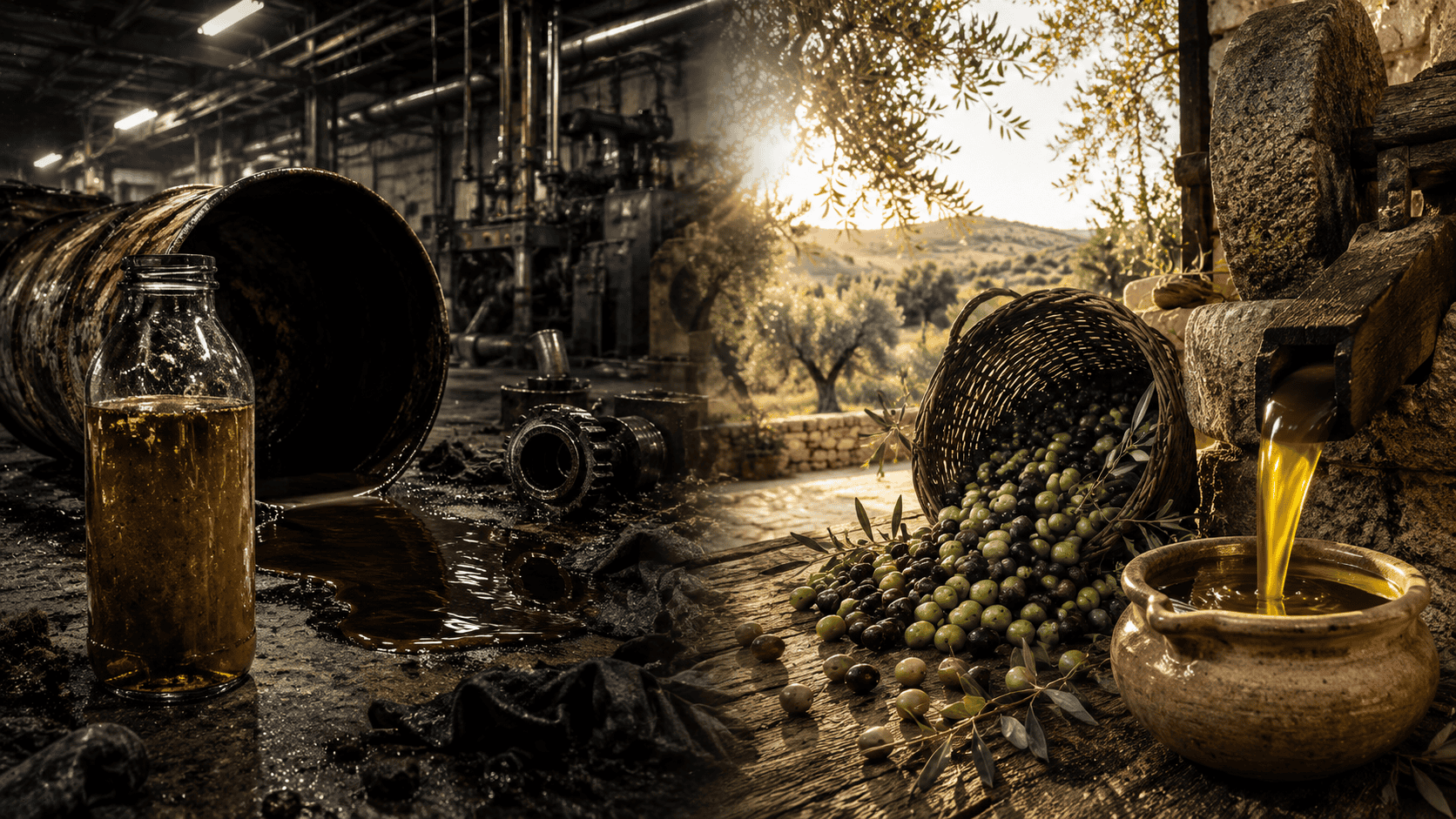
What does the label say versus what is actually in the bottle
Same product. Two completely different descriptions. Which one is closer to the truth determines what happens inside you after lunch.
What you have been told
"Heart healthy." That phrase, stamped by the American Heart Association across canola, soybean, sunflower, and corn oil bottles since the 1980s.
"Polyunsaturated fats lower cholesterol." Repeated in nutrition textbooks, dietary guidelines, and your doctor's office for forty years.
"Plant-based." Carries the moral halo of vegetarian and vegan branding, suggesting closeness to whole food.
"Vegetable oil." The single most misleading two-word phrase in the supermarket. There is no vegetable in it.
What is actually in the bottle
Hexane-extracted oil pressed from cotton seeds, corn germ, soybeans, rapeseed, sunflower seeds. None are vegetables. All require industrial chemistry to extract.
Bleached, deodorized, refined at high heat. The natural color, smell, and flavor are stripped out because what comes out of the seed press is rancid, gray, and inedible.
Omega-6 polyunsaturated fats at concentrations of 50 to 70 percent. The human body evolved on a 1:1 ratio of omega-6 to omega-3. The modern diet runs 20:1 in favor of omega-6.
Oxidized before it leaves the factory. Hits your tissue and continues oxidizing inside cell membranes for years afterward.
The marketing story is one century old. The industrial reality is one century old.Both began the same year. The question this page exists to ask is which one your body has been adapting to.
What are seed oils, in plain English
What are seed oils? They are industrial cooking oils extracted from the seeds of crops that were not historically used for cooking. The category covers eight oils that show up on almost every food label sold in the United States:
Soybean oil (the single most consumed cooking oil in America)
Corn oil (extracted from the germ of corn kernels)
Cottonseed oil (originally a textile-industry byproduct)
Sunflower oil (high-oleic and high-linoleic varieties)
Safflower oil (highest linoleic acid concentration of the group)
Grapeseed oil (winery byproduct, marketed as gourmet)
Rice bran oil (the high-temperature deep-fry standard in chain restaurants)
None of these oils existed in human food in any meaningful quantity before roughly 1910. They are products of 20th-century industrial chemistry. To extract oil from a seed at scale, you need to crush it, soak it in a petroleum-derived solvent called hexane, evaporate the solvent off, then bleach, deodorize, and degum what remains. The final product is a clear, odorless, room-temperature liquid that looks nothing like what came out of the seed.
Compare that to traditional fats. Olive oil is pressed from a fruit and bottled. Butter is churned from cream. Tallow is rendered from beef fat. Coconut oil is pressed from the meat of a coconut. None of these require hexane. None require bleaching. They are foods. Seed oils are food products.
Why are seed oils bad for you, in three sentences
Why are seed oils bad in three sentences? They contain too much of one type of fat (omega-6 linoleic acid), they are produced through a process that pre-damages the fat (oxidation), and once eaten they sit in your tissue for years quietly inflaming everything they touch. The body was not built to process them in the concentrations now found in the modern diet. That is the short answer to are seed oils bad for you from a biochemistry standpoint.
Linoleic acid, the dominant fat in every seed oil on the list above, is technically essential. Your body needs a small amount of it. The 1908 estimate for human linoleic acid requirement was about 1 to 2 percent of total calories. The current American intake is around 8 to 10 percent. That is a five to tenfold increase in a single century. Nothing about human biology changed in that window. The food supply changed.
When linoleic acid is incorporated into cell membranes at these elevated levels, it becomes prone to oxidation. Cell membranes that should hold a stable, fluid structure begin behaving more like surfaces coated in stale frying oil. The downstream molecules generated by this oxidation, including a compound called 4-HNE, are documented contributors to insulin resistance, vascular inflammation, neurological decline, and the cellular damage profile associated with cancer.
This is the part of the story most cooking shows skip. Your body is not just eating the oil. Your body is becoming the oil.
The full mechanism by which oxidized seed oils accumulate in human tissue is mapped across Redacted, Chapter 16. The half-life of linoleic acid in human fat tissue is approximately Redacted, Chapter 16 years, which is why elimination is slow and partial. The peer-reviewed studies showing direct correlation between national seed oil consumption and chronic disease incidence run across Redacted, Chapter 16.

The Master Thyself Book
The full architecture of the food system, and how to step outside it.
When the menu changed
For most of human history, cooking fats came from animals and from fruits like olives and coconuts. Butter, lard, tallow, ghee, olive oil, coconut oil. These were the fats present in every traditional cuisine from Italy to India to West Africa to the American South.
That changed in 1911. Procter and Gamble launched Crisco, the first commercial vegetable shortening, made from hydrogenated cottonseed oil. Cottonseed had been an industrial waste product up to that point, used in soap and machinery lubrication. Procter and Gamble had a vertical supply chain (they made soap from cottonseed) and a marketing department that saw an opening: convince American kitchens that this byproduct was actually superior to lard.
The advertising campaign worked. By 1950, Crisco and its successors had replaced animal fats in the American home. By 1980, the American Heart Association endorsed seed oils as heart-healthy. By 2000, soybean and canola oil had become the dominant cooking fats in the country.
The chronic disease curve maps the same timeline. Heart disease, the leading cause of American death today, was so rare in 1900 that medical textbooks struggled to find case studies. By 1950 it was an epidemic. By 2020 it was killing one American every 33 seconds. Cancer, diabetes, autoimmune conditions, obesity, and Alzheimer's followed similar arcs. Correlation is not causation. But if you are asking are seed oils bad for you using a 120-year mortality dataset, the correlation is tight enough that ignoring it requires effort.
The same hand that engineered the food shift also engineered the dietary guidelines that justified it. The Architecture of Control
Seed oils to avoid, in priority order
The complete list of seed oils to avoid is the same eight oils from earlier in the page, plus the dozens of hidden uses that put them on your tongue without you knowing. Reading a packaged-food label is the entry point. The list of seed oils to avoid in your kitchen is straightforward:
2. Canola oil. Marketed as the heart-healthy oil. Industrial extraction process identical to soybean. The "canola" name is a 1978 marketing rebrand for Canadian rapeseed.
3. Corn oil. Backbone of fast-food fryer oil for thirty years before soybean and canola caught up.
4. Cottonseed oil. Still in commercial baking, peanut butter substitutes, and many shelf-stable snacks. Historically contained gossypol, a natural cotton plant toxin.
5. Sunflower oil. High-linoleic variety is functionally identical to soybean oil. High-oleic variety is closer to olive oil and is the only seed oil with a defensible profile.
6. Safflower oil. Same considerations as sunflower. Avoid the high-linoleic version.
7. Grapeseed oil. Marketed as gourmet because of its high smoke point. The high smoke point is irrelevant if the fat oxidizes at room temperature, which this one does.
8. Rice bran oil. The deep-fry standard in most Asian-American chain restaurants. Same oxidation profile as the rest.
What to use instead: extra virgin olive oil (cold dishes, low heat), avocado oil (medium heat), coconut oil (high heat, baking), grass-fed butter and ghee (high heat, baking), beef tallow and duck fat (frying, roasting). These are real foods that come from places food has always come from.
Where they hide
The visible bottles in your pantry are the smallest portion of total exposure. When you ask are seed oils bad for you as an avoidance question, the real volume comes from places most people would not think to look.
Almost every packaged food. Soybean or canola oil sits in over 70 percent of packaged American food. The specific brand-by-brand audit of major categories (cereals, crackers, breakfast bars, dressings, sauces, condiments) and the cleanest replacements in each, run across Redacted, Chapter 16.
Plant-based meat substitutes. Almost every major vegan alternative uses an industrial oil as its binding fat. Which brands use which oil, and the two notable exceptions worth knowing about, run across Redacted, Chapter 16.
Infant formula. Most major American formula brands include either soybean or palm oil. The linoleic acid load to a developing infant matters more than to an adult. The specific brand-by-brand profile and the one or two formulas with a defensible fat composition, run across Redacted, Chapter 16.
"Olive oil" blends. Many supermarket olive oils are not what the label suggests. The seven major supermarket brands whose contents have been independently lab-tested and found to contain less than 20 percent actual olive oil, plus the analysis methodology, runs across Redacted, Chapter 16.
Total exposure for the average American is somewhere between 8 and 14 percent of total daily calories from seed oils. For an adult eating 2,500 calories per day, that is 200 to 350 calories per day, every day, year after year, accumulating in fat tissue with a half-life measured in years. The math compounds.
How to get them out
Once you have accepted that yes, seed oils are bad for you, the operational question becomes how to limit exposure and rebuild the fat composition in your tissue. Reducing exposure is the easier half. Restoring tissue composition is the longer half. Both matter.
For reduction: swap cooking oils at home (the eight listed above for olive, avocado, coconut, butter, ghee, tallow, or duck fat). Read labels on packaged goods. Eat at restaurants that disclose their cooking fat. Ask. Most servers will tell you if they know. Most do not know, which itself is informative.
For restoration: the body's existing linoleic acid stores deplete on a timeline measured in years, not weeks. The half-life of linoleic acid in human adipose tissue is roughly two years, which means significant tissue change takes about four to six years of strict avoidance. The transition is not linear. Most people report energy and inflammation changes within months. Full tissue turnover takes longer.
What helps the transition: increasing saturated fats from real animal sources (butter, ghee, tallow, coconut), adequate vitamin E from whole foods, reasonable sunlight exposure, and patience. The body is doing the work. Stop adding to the pile.
This is one front of a larger reset. The body as temple, the food system as architecture, the dietary guidelines as instrument. The Body As Temple
If they had to call it what it actually is, you would never have bought it.
Twelve questions the book answers
Each question is a doorway. The book opens all of them, with sources.