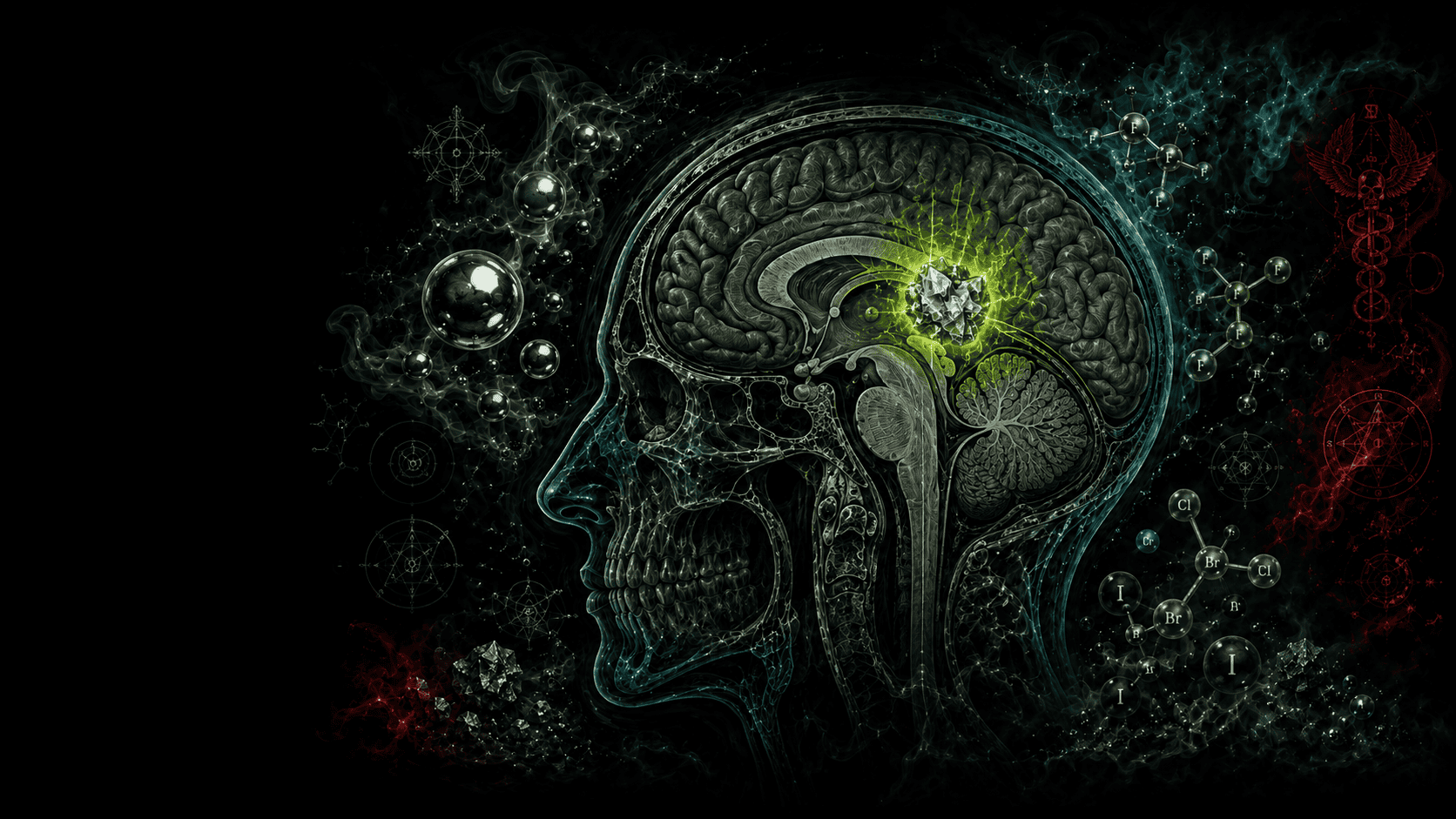
Pineal Gland Toxins
A 2023 meta-analysis in Systematic Reviews found that over 60% of the general population already shows measurable pineal gland toxins and calcification.
The pineal gland sits outside the blood-brain barrier and is one of the most highly vascularized organs in the body. That makes it uniquely vulnerable to pineal gland toxins moving through your bloodstream. The substances calcifying it are in your water, your toothpaste, your food, and the air you sleep in. Every one of them is legal, commercially available, and almost never questioned. This page lists what pineal gland toxins are hitting the organ tradition called the seat of the soul, where each one comes from, and how the load stacks. The decalcification protocol lives at /how-to-decalcify-pineal-gland/. You cannot reverse what you keep doing every day, so the audit comes first.
The pineal is still working. Pineal gland toxins are burying it in stone
Pineal calcification is not damage in the destructive sense. It is calcium phosphate building up inside the gland in layers, year after year, in response to pineal gland toxins that very few people track. Two columns below. The left names what drives the buildup. The right names what prevents it. The full chapter list and the sources sit in Master Thyself, Chapter 15.
Pineal gland toxins hardening the seat of the soul
- Fluoride - municipal water, fluoridated toothpaste, certain teas grown in fluoride-rich soils, non-stick cookware. The single best-documented pineal toxin in peer-reviewed literature.
- Mercury, lead, cadmium - amalgam fillings, old paint, lead pipes in older housing, cigarette smoke, contaminated seafood. Cross the blood-brain barrier and accumulate in soft tissue.
- Chlorine and chloramine - municipal tap water disinfection byproducts. Halides compete with iodine at receptor sites the thyroid and the pineal both rely on.
- Bromide - commercial bread (potassium bromate), citrus-flavored sodas (brominated vegetable oil), some flame retardants. Another halide displacing iodine.
- Industrial seed oils - soybean, corn, canola, sunflower, safflower. Oxidized polyunsaturated fats that inflame the brain and crowd out omega-3s the pineal membranes need.
- Refined sugar and ultra-processed food - chronic insulin spikes drive inflammation. The brain runs poorly on glucose chaos.
- Calcium-fortified dairy without K2 and D3 - the calcium ends up where you do not want it. Vitamin K2 directs calcium into bone and teeth. Without it, calcium deposits in soft tissue, including the pineal gland.
- Artificial blue light after dark - phones, tablets, TVs, ceiling LEDs. Suppresses melatonin output and disrupts circadian signaling the gland depends on.
- Alcohol - directly suppresses melatonin and corrupts the circadian rhythm. Routine intake compounds pineal toxin effects.
- Redacted, Chapter 15 two more pineal gland toxins with industry-specific exposure routes
What clears pineal toxins and supports the gland
- Fluoride-free water - reverse osmosis, activated alumina, or bone char filtration. Standard carbon filters do not remove fluoride and other pineal gland toxins.
- Tamarind - a 2002 clinical study in the European Journal of Clinical Nutrition found 10 grams per day raised urinary fluoride excretion by 37%. Effective for clearing pineal toxins from bone storage.
- Iodine - displaces fluoride, chlorine, and bromide from receptor sites by holding the seat that belongs to it. Protects against future pineal gland toxins.
- Chlorella and spirulina - bind heavy metals including mercury, lead, and cadmium for excretion. Targets the heavy metal pineal toxins directly.
- Magnesium - prevents soft-tissue calcification and supports the mitochondria that power the gland.
- Vitamin K2 with D3 - K2 sends calcium to bones and teeth instead of arteries and the pineal.
- Morning sunlight - resets circadian rhythm and supports clean melatonin cycling without toxin interference.
- Darkness discipline - sleep in true darkness. Eyelids are not blackout curtains.
- Fasting - autophagy clears damaged material from glandular tissue. A landmark animal study found food restriction produced melatonin levels twice as high as controls.
- Redacted, Chapter 22 the full restoration protocol for clearing pineal gland toxins
Fluoride: the pineal gland toxin in the water supply
In the 1990s, Dr. Jennifer Luke of the University of Surrey discovered that the pineal gland accumulates more fluoride than any other soft tissue in the human body. Its internal calcite microcrystals concentrate fluoride at levels exceeding both teeth and bone. Those same crystals interfere with melatonin production and the gland's regulation of the entire endocrine cascade. Fluoride is classified as a neurotoxin in multiple peer-reviewed studies and it crosses the blood-brain barrier. Public health agencies still frame it as safe and effective.
Officially, water fluoridation began as a public health measure in 1945. What the official story leaves out is where pineal gland toxins like fluoride actually come from. It is a toxic byproduct of aluminum refining and phosphate fertilizer manufacturing. Reframing it from industrial waste to a public health additive solved two problems at once: it reduced corporate liability and created a revenue stream from a substance that would otherwise cost money to dispose of. The architects of control do not always operate through malice. Sometimes they operate through convenience. The result is the same either way. The organ most responsible for inner perception gets calcified from pineal gland toxins building up inside.
A fluoridated population does not just suffer in silence. It may be chemically inclined to. Researchers and historians have alleged that Nazi-occupied territories were deliberately fluoridated to produce a compliant, docile population, one less capable of organizing resistance. The IG Farben connection to both Bayer and the Nazi war machine is thoroughly documented. Whether the wartime fluoridation account holds at every detail or not, the logic is worth sitting with. A substance that calcifies the seat of inner perception, suppresses the endocrine system, and crosses the blood-brain barrier does not need a conspiracy behind it to serve one. A passive population is easier to govern. A dimmed third eye does not ask uncomfortable questions.
The industry response to widespread pineal damage from fluoride toxins is predictable. Sell a pill. Melatonin supplement sales in the U.S. went from under $100 million in the early 2000s to over $820 million by 2022. Most are lab-synthesized. Chronic use risks suppressing the gland's own production and masks the real causes: late-night screens, inflammatory diet, pineal gland toxins like fluoride accumulation. The dependency replaces the restoration. Fix the environment that damaged the gland and the gland can recover on its own terms. Redacted, Chapter 15 covers the full Bayer and Monsanto regulatory capture lineage.
Heavy metal pineal gland toxins: mercury, lead, and cadmium
Heavy metals are the second front of pineal gland toxins. They are introduced through dental amalgam fillings, lead pipes in pre-1986 housing, lead-based paint in older homes, cigarette smoke, contaminated seafood (especially large predator fish), and certain non-organic farming residues. Once in the body, they cross the blood-brain barrier and lodge in soft tissue. The pineal, being highly vascularized and outside the blood-brain barrier, sees disproportionate exposure to these pineal toxins.
Mercury is the worst of the three heavy metal pineal gland toxins for neurological function. It disrupts mitochondrial energy production, impairs antioxidant defenses, and accumulates over decades. Symptoms of subclinical mercury burden look like aging: brain fog, mood instability, fatigue, sleep disruption. Lead behaves similarly and is particularly damaging to developing nervous systems. Cadmium is most often introduced via cigarette smoke and industrial soil contamination as a pineal toxin.
Chlorella and spirulina, both single-cell algae, bind heavy metal pineal gland toxins in the gut and carry them out through stool. Peer-reviewed research confirms their antioxidant, anti-inflammatory, and immune-modulating effects against pineal toxins. Cilantro is often combined with them in chelation protocols because it appears to mobilize metals from tissue while chlorella binds and removes them.
The halide hijack: pineal gland toxins from chlorine, bromide
Iodine, fluoride, chlorine, and bromide are all halides. They share the same chemical column on the periodic table and compete for the same receptor sites in the thyroid and the pineal. Iodine is the one the body wants in those seats. Fluoride, chlorine, and bromide are not supposed to be there. When environmental exposure to pineal gland toxins like the wrong halides is high and iodine intake is low, the wrong halides take seats they were never meant to occupy.
Chlorine arrives through tap water disinfection. It serves a real purpose in preventing waterborne disease but the cumulative chronic exposure to pineal gland toxins like chlorine was never the design intent. Chloramine, used in many municipalities, is harder to remove than chlorine and persists in showers and baths where it is absorbed through skin and inhaled as vapor. Bromide is in commercial bread (as potassium bromate, banned in most of Europe and still legal in the U.S.) and in citrus-flavored sodas (brominated vegetable oil). It is also a common flame retardant in furniture and electronics, exposing people to pineal toxins daily.
The fix is simple in principle. Restore iodine status (sea vegetables, iodized salt, or supplementation with practitioner guidance), filter pineal gland toxins like chlorine out of drinking and shower water, and read labels for bromated products. The body releases the wrong halides faster when the right one is sitting at the receptor.


The Complete Pineal Gland Toxins Protocol
Every pineal gland toxin, every source, every regulatory capture story, every removal protocol, with citations. Plus Chapter 22 on the restoration sequence in full.
Modern pineal gland toxins: EMF, blue light, and oxidized seed oils
The pineal is light-sensitive even when the eyes are closed. Blue-spectrum light from screens suppresses melatonin production and disrupts the sleep architecture the gland depends on to clear toxins. Two hours of phone use after sunset can flatten the melatonin curve for the rest of the night. The gland does not get a chance to do its work clearing pineal gland toxins.
Electromagnetic field (EMF) exposure is the newer load of pineal gland toxins. The pineal contains magnetite-rich tissue and responds to geomagnetic shifts as a baseline biological function. The body was built to read the geomagnetic field, including the measurable shift that occurs at each new moon. Adding chronic 60 Hz field exposure from house wiring, plus 2.4 and 5 GHz Wi-Fi signaling, plus cellular radiation from devices kept on the body, gives the gland a noisy environment to operate in. The research base on chronic low-level EMF and pineal function is still building, but the practical move is conservative: keep phones off your body and out of the bedroom at night, hardwire your work setup where you can, and turn off Wi-Fi during sleep to protect the pineal from these toxins.
Industrial seed oils are the third modern category of pineal gland toxins. Soybean, corn, canola, sunflower, and safflower oils were never part of the human diet until the early 20th century. They were industrial products: soap, paint, varnish, lubricants. Marketing campaigns reframed them as heart-healthy alternatives to animal fats. The fatty acid profile crashes the omega-6 to omega-3 ratio from roughly 1:1 in ancestral diets to 20:1 or higher in modern Western intake, introducing oxidized toxins that harm pineal function. The result is systemic inflammation, including in the brain and the membranes of the pineal itself.
Why 60% of the population carries pineal gland toxins
Every item on the pineal gland toxins stack is legal, commercially available, and consumed daily by hundreds of millions of people. None of them carries a warning label about pineal health. Individually, each is defended as harmless in small amounts. Collectively, pineal gland toxins form a chemical siege on the organ traditions across every culture called the seat of the soul. The 2023 meta-analysis is not surprising once you list the inputs of pineal toxins. It would be more surprising if calcification rates were lower.
The pattern is not unique to fluoride or pineal gland toxins. It runs through the entire food and water supply: profit over safety, regulatory capture, and deniability by design. Bayer's corporate history, the Monsanto glyphosate story, the seed oil reframing, the fluoride byproduct repurposing, all share the same shape. The architects of control do not need to coordinate. They only need a system where chronic harm from pineal gland toxins is profitable and acute harm gets the headlines.
Chapter 15 walks through the full pattern of pineal gland toxins with sources. Chapter 22 walks through what the restoration protocol looks like over weeks and months. The pages on this site cover the inputs piece by piece. The book covers the whole system. Redacted, Chapter 15 includes the full corporate capture timeline.
Questions on pineal gland toxins the book answers
Each question is a doorway into the full protocols for clearing pineal gland toxins.