What Does the Bible Actually Say About Eating Meat?
A verse most Christians have read a hundred times. Two pages after the flood. Almost nobody registers what it actually says.
What does the Bible say about eating meat? The honest answer changes depending on which chapter you read. Eden permitted no flesh. Post-flood Genesis permitted everything. Revelation removes death from the menu entirely. Which moment of scripture are you choosing to live in?
What does the Bible say about eating meat? The text says two different things
Same Bible. Two verses, eight chapters apart. They look contradictory on the surface. Read them side by side and the real answer to what does the Bible say about eating meat becomes clear.

God made vegetarians
Designed body. Designed diet. Designed for centuries of life.
"Behold, I have given you every herb bearing seed, which is upon the face of all the earth, and every tree, in the which is the fruit of a tree yielding seed; to you it shall be for meat."
That was the menu. Herbs, seeds, fruit. No flesh, no blood, no slaughter.
Genesis 1:30 extends the same instruction to every beast of the earth, every fowl of the air, every creeping thing on the ground. Even the lion ate plants. The original order had no death in the food chain anywhere.
So did Adam and Eve eat meat? No. The text is unambiguous. Eden was vegetarian by design, and stayed that way until something catastrophic broke it.
God conceded meat. The body never changed.
The menu got permission. The biology did not get a redesign.
"Every moving thing that liveth shall be meat for you; even as the green herb have I given you all things."
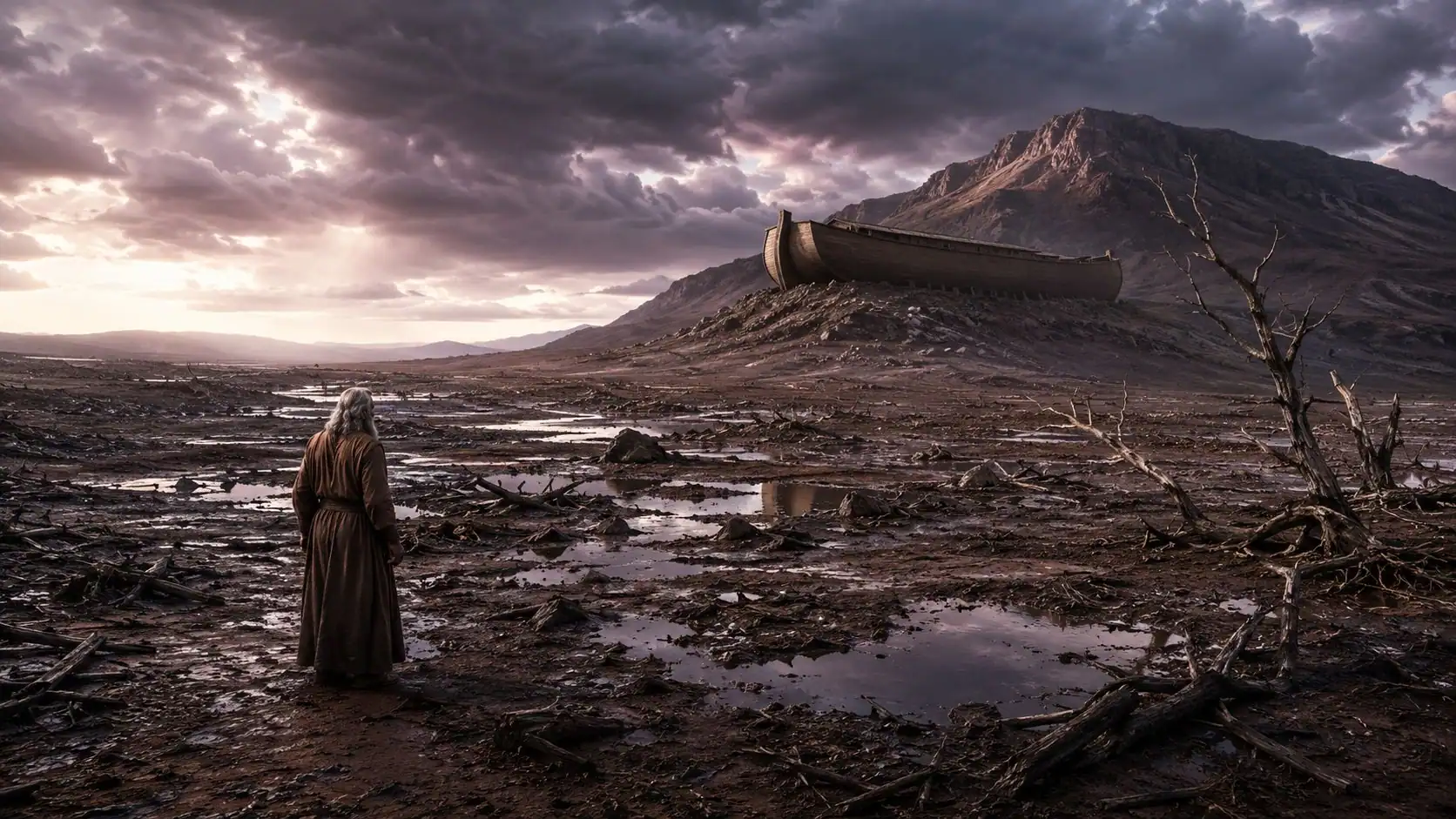
Picture the context. Noah stands on Ararat after the waters recede. Every tree drowned. Every fruit, every herb, every grain gone. God had just devastated the planet. Genesis 9:3 is permission to survive in a world the design no longer fit.
Read what the verse does and does not say. It grants moving things "for meat," but offers no redesign of the body that will receive them. The human digestive tract did not lengthen. The teeth did not sharpen. The stomach acid did not strengthen to match a wolf or a hyena. The biology stayed vegetarian. Only the permission changed.
The verse does not say "this was always intended." It does not say "this is now optimal." It does not say "forever." It says "shall be," in a specific moment, to a specific man, standing in a specific ruin.
The lifespans drop immediately. Within four generations the average is one fifth of what it was. The body never adapted. The cost of the concession is the chart below.
The emergency was real. So was the concession.The question this page exists to ask is whether we kept the emergency response long after the emergency ended.
The lifespan collapse that followed
Before the flood, the Bible records lifespans most modern readers dismiss as impossible. After the flood, those lifespans collapse, sharply and immediately, and the decline tracks one variable: meat enters the diet. This is the part of what does the Bible say about eating meat that most pulpit sermons skip. The numbers are sitting right there in Genesis chapter 5 and Genesis chapter 11.
Genesis 5 names seven more patriarchs in the pre-flood genealogy between Adam and Noah: Redacted, Chapter 15, Redacted, Chapter 15, Redacted, Chapter 15, Redacted, Chapter 15, Redacted, Chapter 15, Redacted, Chapter 15, and Redacted, Chapter 15. Their lifespans run between Redacted, Chapter 15 and Redacted, Chapter 15 years. The soil chemistry argument for why pre-flood biology made this possible runs across Redacted, Chapter 15.
Look at the shape of that. A 90% drop, occurring inside a handful of generations, locked precisely to the dietary inflection point in Genesis 9:3. Right before the flood, in Genesis 6:3, God himself declares the new cap: "his days shall be an hundred and twenty years." Moses dies at exactly that number. The decree is fulfilled in the text.
The lifespan question alone has its own deep dive: Why did people live so long in the Bible?
And here is what makes the biblical record harder to dismiss: the same impossible ages appear in the oldest written records on Earth. Sumerian cuneiform tablets, dating to roughly 4,000 BCE, record kings reigning for tens of thousands of years before "the flood that swept over the land." The genealogies in Genesis are not a unique claim. They are one survivor of a much older record. The Older Record

The Master Thyself Book
The full case file. What else was hidden in (or from) the Bible?
Your body is already the verdict
Here is where the conversation usually breaks down. Someone reads the verses above and says "But God permitted it, so it must be fine." Permission is not the same as design. The body answers the design question if you ask it.
Look at the digestive anatomy you were built with, compared to the actual carnivores and herbivores in nature:
Herbivores (cows, deer, horses): very long intestines, up to 30 times body length, often with multiple stomach chambers. Their stomach acid is weak, because plant matter does not require strong acid to break down.
Humans: intestines roughly 8 to 10 times body length. Significantly closer to the herbivore profile. Our stomach acid is in the same range as plant-eaters, far weaker than any obligate carnivore. Our jaws move side to side, the chewing motion of a grazing animal. Carnivores cannot do this. Their jaws only move up and down for tearing. Our saliva contains amylase, an enzyme (a protein that breaks down food chemically) for digesting starch. Carnivores produce no amylase. Their food does not require it.
The intestinal and oral anatomy is the starting point, not the conclusion. Five more body systems point in exactly the same direction: Redacted, Chapter 15, Redacted, Chapter 15, Redacted, Chapter 15, Redacted, Chapter 15, and Redacted, Chapter 15. Each is documented in peer-reviewed literature. None of them matches the carnivore profile.
The proof shows up in transit time, which is how long food actually takes to move through your gut:
Fruit and simple carbohydrates: about 6 hours.
Cooked grains and fish: 18 to 36 hours.
Red meat and animal flesh: 2 to 3 days, sometimes longer.
Three days inside a body built to move food in hours. That is not digestion. That is fermentation and putrefaction. Your gut is doing damage control on cargo it was not designed to carry.
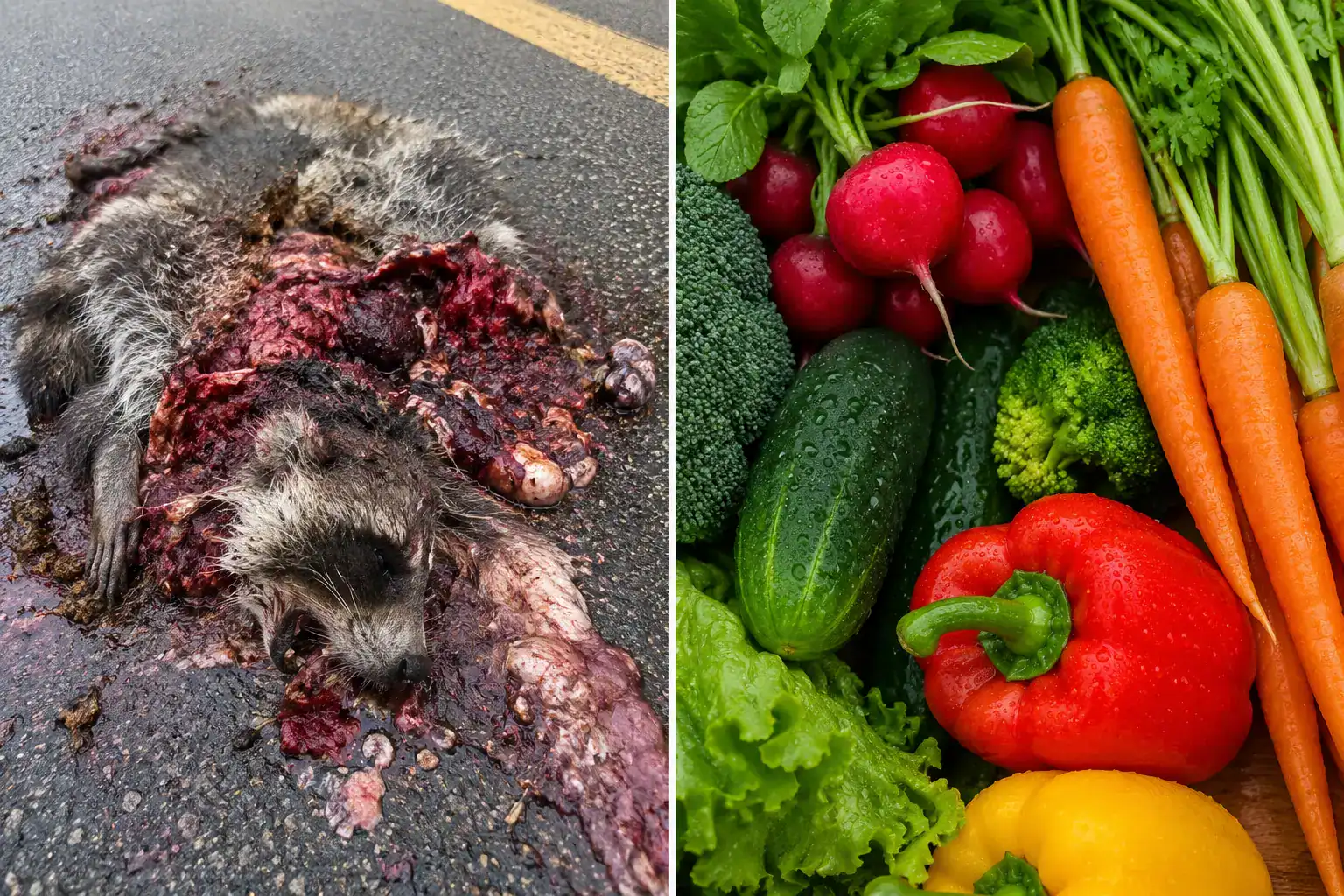
Here is the test that settles the argument every time:
Picture roadkill on the highway. A flattened deer, blood on the asphalt, ribs showing. Notice what happens in your body when you imagine it. Nothing stirs. No salivation, no appetite, no impulse to pull over and feed. Now picture a lion driving by that same scene. The lion stops.
That gap is not squeamishness. That gap is anatomy reporting itself.
Children, before cultural conditioning kicks in, reach for fruit over raw meat every time. Adults need to season, cook, marinate, sauce, and disguise animal flesh before it becomes palatable. Almost every cooking method for meat depends on plants, the herbs, the spices, the marinades. We dress animal protein in the very foods we are told we do not need, just to tolerate eating it. So what does the Bible say about eating meat when you stop reading the text and start reading the body it built? The verdict is already written into your anatomy.
And what about dairy?
The same biological framework that answers what does the Bible say about eating meat points in exactly the same direction on dairy.
Humans are the only mammal on Earth that drinks milk past weaning. Every other species, including our closest primate relatives, weans off milk between 2 and 4 years old and never touches it again. Mother's milk is a developmental tool for infancy, not adult food.
The genetic ability to digest lactose (the sugar in milk) past childhood is a relatively recent mutation, traced to roughly 7,500 years ago in northern European herding populations. It is the exception, not the rule. Roughly 65 to 70 percent of the global adult population is lactose intolerant. Tolerance, not intolerance, is the genetic anomaly.
Then there is what the dairy industry requires that most consumers never see. A dairy cow has to be perpetually pregnant to keep producing milk. Each calf she bears is taken from her within hours of birth. The female calves enter the dairy herd to repeat the cycle. The male calves, who cannot produce milk and serve no purpose in the operation, are typically killed within days or sold for veal at a few weeks old. Every gallon of commercial milk requires the slaughter of male calves the consumer will never know existed.
The biological argument and the ethical argument arrive at the same place. Dairy is a recent industrial overlay on a body that did not evolve to need it past weaning, sustained by a process most people would not endorse if they saw it.
The specific documented health impacts of routine adult dairy consumption, including the inflammation, mucus, and hormone disruption pathways, run across Redacted, Chapter 15. The actual statistics behind male calf disposal in industrial dairy, and the documentary evidence that put it on record, run across Redacted, Chapter 16. The single best plant-based replacement for each dairy product, calorie for calorie and mineral for mineral, runs across Redacted, Chapter 15.
The mental exercise the Bible never asked you to do
Now sit with a visualization. It is not a verse. The verses were the setup. This is the test.
Close your eyes. Picture Jesus.
Picture the figure you have seen in stained glass, in Sunday school books, in every painting of the Good Shepherd from the last 1,500 years. The man holding the lamb gently on his shoulders.
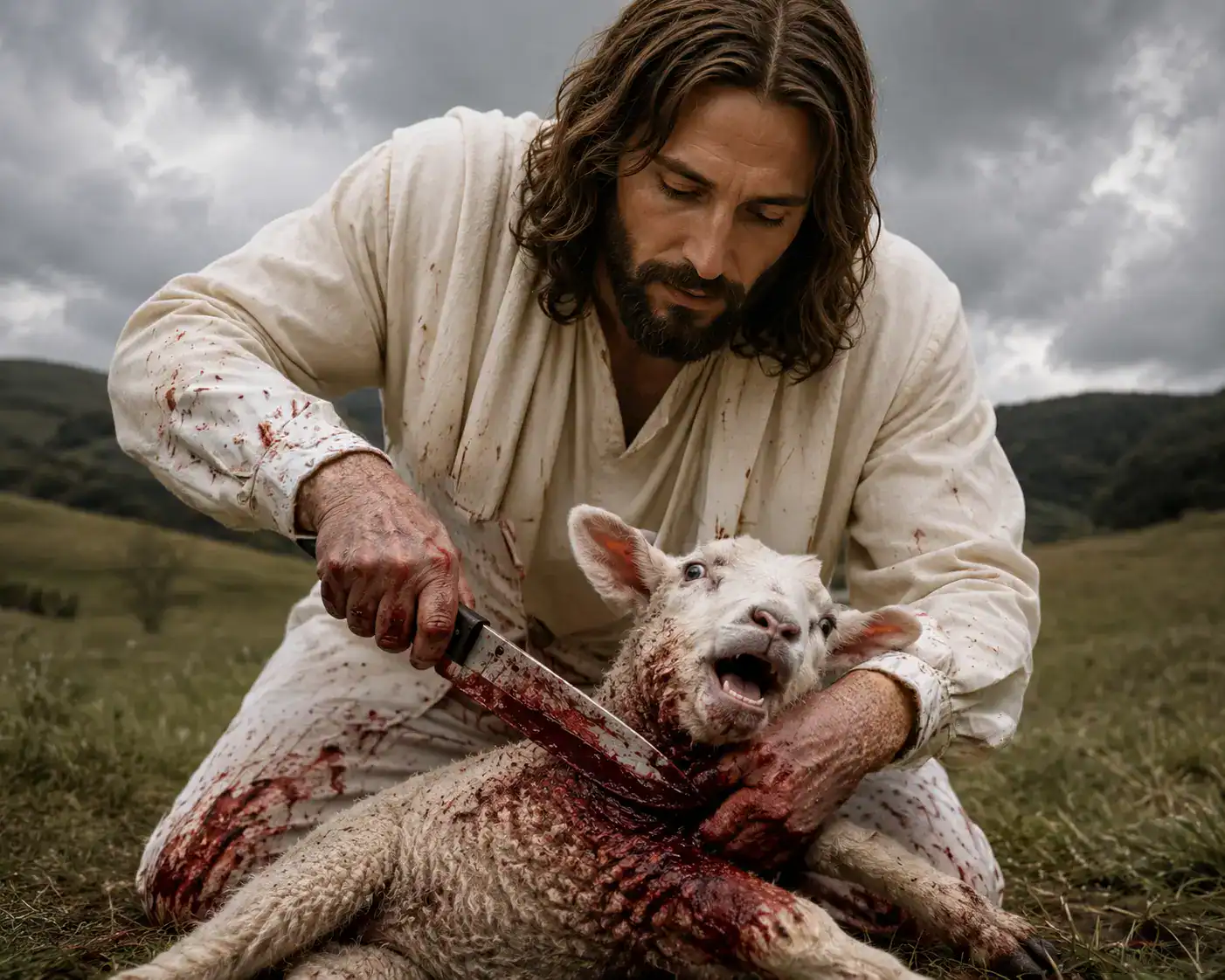
Now picture him walking up behind that lamb. Picture him holding its head back. Picture him drawing a blade across its throat while it struggles.
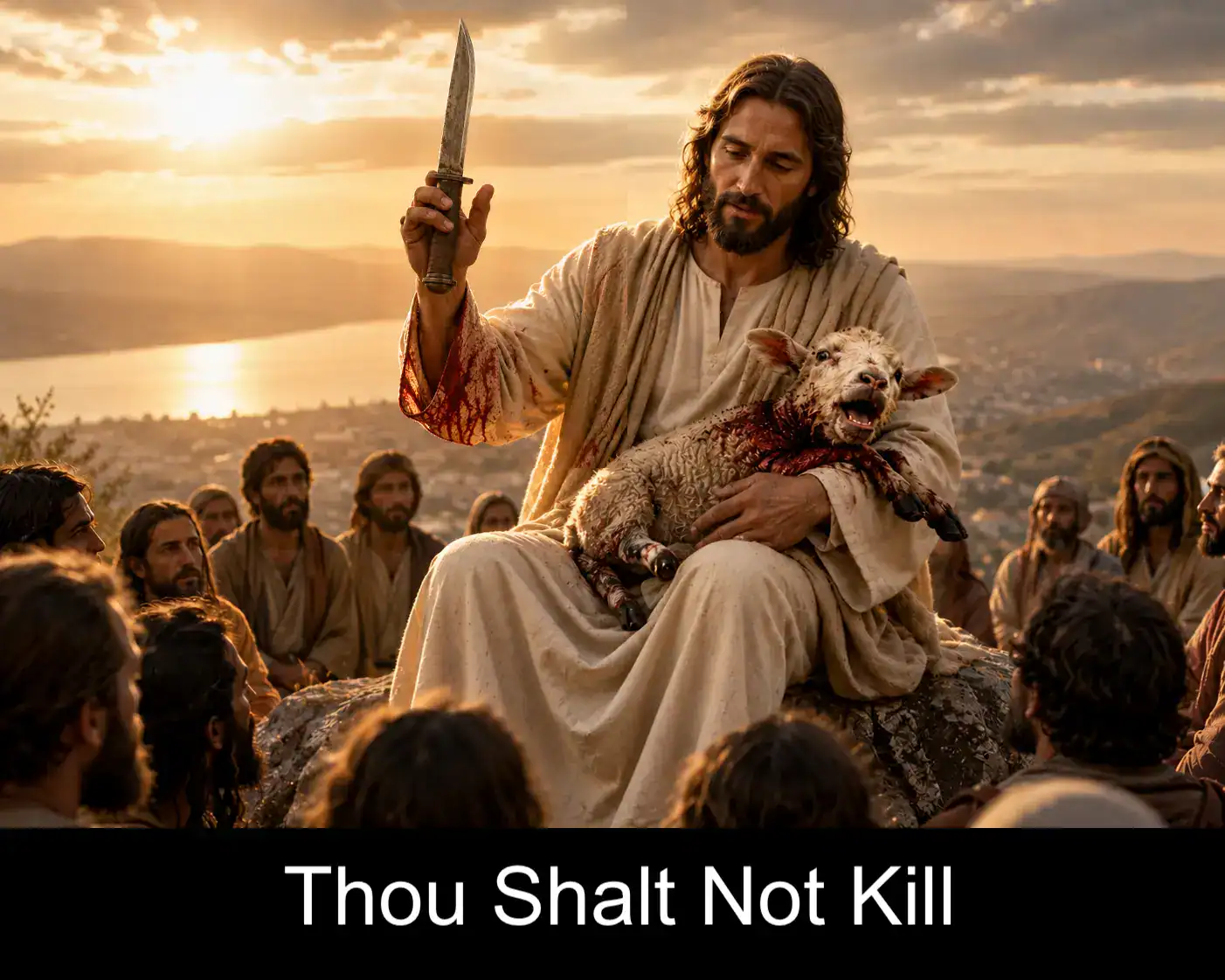
A note on the commandment in the image. The original Hebrew is lo tirtzach, which most modern translations render as "thou shalt not murder" rather than "thou shalt not kill." The King James Version, the translation most English-speaking Christians grew up reading, used "kill." The image carries that older phrasing. The technical distinction matters for legal interpretation, since Mosaic law explicitly allowed animal sacrifice in the temple.
But the visualization above does not need the commandment to do its work. The recoil happens whether you read it as murder or as killing in the broader sense. The recoil happens because something in you knows that the Prince of Peace, the Good Shepherd, the one who said "blessed are the merciful," does not match the act in the image.
Most people cannot hold the picture for more than a few seconds. The mind slides off it.
That sliding is data. What that recoil is actually telling you, about your own consciousness and about the food on your plate, is mapped in chapter 15. Redacted, read Chapter 15
Did Jesus eat meat? What the Gospels actually record
Did Jesus eat meat? It is the most-asked Bible-and-diet question on the internet, and the honest answer requires looking at three specific moments in the Gospels. Be honest about what the text does and does not say. The Gospels record three meat-adjacent moments in Jesus's life, and the related question of what meat did Jesus eat narrows the answer further. None of them is what most Christians assume.
He ate fish after the resurrection (Luke 24:42-43). The text says so plainly. We will not pretend otherwise. Fish, biologically and chemically, sits closer to the plant kingdom than red meat does, rich in omega-3 fatty acids (a type of healthy fat the body needs) and trace minerals that mirror sea plants more than land mammals. So when people ask did Jesus eat meat in the categorical sense, the answer from the text is: once, briefly, after the resurrection, and it was fish. And when people ask the narrower question, what meat did Jesus eat, the Gospel record gives a single answer: fish, never lamb, never beef, never pork, never any land animal at all. There is no Gospel record of him eating any land creature, ever.
He was present at Passover meals, where lamb was traditional. The Gospels do not record him personally killing a lamb. They do not record him eating one either. The Last Supper, the meal he chose to institute as ongoing remembrance, used bread and wine. Not lamb. He could have made lamb the sacrament. He did not.
He cleared the temple of animal sellers. Matthew 21 and John 2 have him driving out the merchants and overturning the tables of those selling animals for sacrifice. Whatever you think this means theologically, it is not a man celebrating the slaughter trade.
And in Mark 7:18-19, he tells his disciples that what enters the mouth does not defile a person, because it does not enter the heart. This is the verse most often cited to argue that yes, Jesus ate meat and endorsed it. Read in context it does not say that. It says: stop fixating on dietary purity as the measure of righteousness. The verse is the closest thing in the Gospels to a direct comment on the did-Jesus-eat-meat question, and even there, he is rebuking dietary obsession, not endorsing the slaughter trade. He did not say "meat is good." He said "stop fighting about it."
Daniel and the king's meat
Daniel chapter 1. The young Daniel and his three companions, taken captive into the royal court of Babylon, are assigned the king's rich food: meat, wine, the finest of everything available. Daniel refuses. He proposes a test.
"Prove thy servants, I beseech thee, ten days; and let them give us pulse to eat, and water to drink." (Daniel 1:12)
Pulse means legumes and vegetables. Just plants and water. For ten days.
The result, recorded in Daniel 1:15:
"And at the end of ten days their countenances appeared fairer and fatter in flesh than all the children which did eat the portion of the king's meat."
The vegetarian test won the contest. The text is unambiguous. This is the only diet-versus-diet experiment in scripture, conducted under royal supervision, with comparison subjects. And the plants won. If you want to know what does the Bible say about eating meat versus eating plants in a head-to-head trial, the answer is in Daniel 1. The Bible itself ran the experiment.
The story is so foundational that twelve verses later, the same four young men are described as ten times wiser than the king's magicians and astrologers. The text connects their food choice to their cognitive sharpness directly. The conclusion the chapter draws is not subtle.
What the early Christians knew
If you want to understand what does the Bible say about eating meat from the earliest Christian sources, you have to read past the four Gospels that made the canon. The four canonical Gospels are not the only Gospels that were circulating in the first three centuries after Christ. Before the canon was sealed at the councils of Hippo (393 AD) and Carthage (397 AD), multiple gospels and apostolic acts were in active use by early Christian communities. Many of them counseled abstention from animal flesh as part of spiritual practice.
The Gospel of the Egyptians counsels a return to the Edenic state, framed explicitly as rejection of killing.
The Clementine Homilies describe eating flesh as a polluting practice tied to idol worship, equating it with sharing a table with darker forces.
At least six additional pre-canonical texts in circulation before the canon was sealed taught the same dietary instruction: the Redacted, Chapter 12, the Redacted, Chapter 12, the Redacted, Chapter 12, the Redacted, Chapter 12, the Redacted, Chapter 12, and the Redacted, Chapter 12. What each one taught, who circulated them, and what was at stake in burying them, runs across Redacted, Chapter 12.
None of these texts made the canon. All of them existed, were read aloud in early house churches, and shaped the practice of the first three Christian generations. The fact that you have probably never heard of any of them is not an accident of history. It is editorial.
A dietary instruction this consistent across early Christianity does not get buried by accident. The same mechanism that erased these gospels also engineered what replaced them on the modern plate. The Architecture of Control
The Romans 14 rebuttal
You will hear this verse cited every time the question comes up. Romans 14:14:
"I know, and am persuaded by the Lord Jesus, that there is nothing unclean of itself."
The argument is that Paul gave permission to eat anything, therefore the matter is settled. Read the verse in its actual context.
Paul is writing to a mixed congregation in Rome where Jewish Christians (still keeping kosher) and Gentile Christians (not bound by Mosaic law) were judging each other over what was on each other's plates. The whole chapter is about not destroying community over dietary disputes. Paul's point is to stop weaponizing food rules against one another.
He is not saying "go eat factory meat, it is the design." He is saying "do not let what you eat divide what God is building."
And the verse cuts both ways. If all food is permitted, then questioning your food is also permitted. The pretense that Romans 14 ends the conversation is itself a way of weaponizing the verse to enforce a categorical answer, which is the exact behavior Paul was telling them not to do.
Paul's freedom is real. It is the freedom to ask. Not the freedom to stop asking. Romans 14 does not answer what does the Bible say about eating meat. It answers a different question, which is how to live in community with people whose answer differs from yours.
Eden restored
Now read how the Bible ends. Isaiah 11:6-9, the prophetic vision of the world to come:
"The wolf also shall dwell with the lamb, and the leopard shall lie down with the kid; and the calf and the young lion and the fatling together; and a little child shall lead them. And the cow and the bear shall feed; their young ones shall lie down together: and the lion shall eat straw like the ox."
The lion eats straw. The world without killing. The original design, restored.
Revelation 21:4, the last book of the Bible, the new heaven and new earth:
"And God shall wipe away all tears from their eyes; and there shall be no more death, neither sorrow, nor crying, neither shall there be any more pain."
No more death. No more pain. The killing of animals for food is, by definition, death and pain. The new earth does not have it.
The Bible opens with vegetarian Eden. The Bible closes with vegetarian Eden. The middle is the concession, not the goal. The arc from Genesis 1:29 to Revelation 21 is a long loop around an emergency, ending exactly where it started.
So what does the Bible say about eating meat? It says you are permitted to. It also says you were not designed for it, and that the world it points to does not contain it. The question is not whether you are allowed. The question is which direction of the arc you are walking.
What else was hidden in (or from) the Bible?
Twelve questions the book answers
Each question is a doorway. The book opens all of them, with sources.