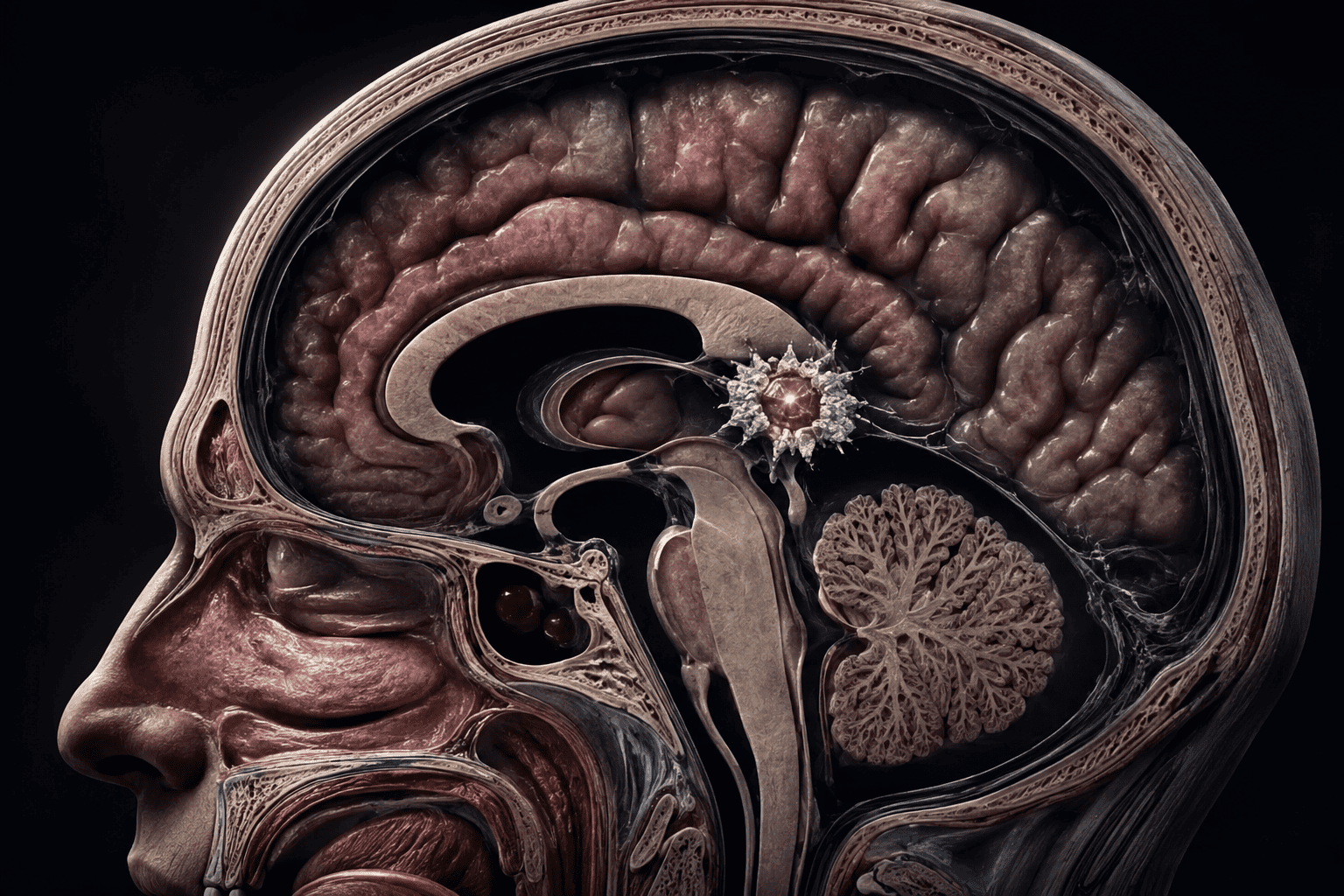
How to Decalcify the Pineal Gland
A pea-sized gland in the center of your brain, encased in mineral deposits before most people turn 18. The full protocol to reverse it.
How to decalcify pineal gland in plain English: stop adding to the calcium load, support the body's own dissolution chemistry, and give it years to clear. The pineal is decalcifiable. Most modern brains have just never tried.
To decalcify the pineal gland, you have to stop calcifying it first
The gland is in a constant chemical conversation with what you eat, drink, breathe, and feel. Two columns. One pushes the calcium in. The other lets it out. Most modern lifestyles run the left column on default.
What is hardening the gland right now
Seven primary calcifiers documented in peer-reviewed literature. Each operates on a different mechanism. The full list, what each one is, where it enters the body, and how it locks calcium into the gland, is in the book.
- Redacted, Chapter 14
- Redacted, Chapter 14
- Redacted, Chapter 14
- Redacted, Chapter 14
- Redacted, Chapter 14
- Redacted, Chapter 14
- Redacted, Chapter 14
You cannot decalcify what you do not stop calcifying first. The diagnostic comes before the protocol.
What is dissolving the deposits
- Filtered water. A solid reverse-osmosis or distillation filter eliminates fluoride. The single most impactful first step.
- Fluoride-free toothpaste and the elimination of all fluoride dental treatments.
- Vitamin K2 (MK-7) with D3. Directs calcium out of soft tissue and into bone, where it belongs.
- Magnesium (glycinate, citrate, or threonate). The cofactor for calcium regulation throughout the body.
- Iodine and trace minerals in food form. Sea vegetables, real salt, organic produce.
- Sungazing at safe times (within an hour of sunrise or sunset). Stimulates the gland directly.
- Fasting, meditation, and reduced screen time. The gland responds to attention and to silence.
You cannot decalcify your pineal gland while you are still calcifying it.The right column is meaningless if the left column runs every day on autopilot. Start by stopping.
What the pineal gland actually does
The pineal gland is a pea-sized endocrine gland (a gland that releases hormones into the bloodstream) located near the center of the brain, in the third ventricle. It sits at the geometric midpoint of the skull. Every ancient anatomical tradition that mapped the human body placed it at the center for a reason.

Its scientifically documented functions are clear. It produces melatonin, the hormone that governs your sleep-wake cycle. It mediates circadian rhythms across the body. It responds to light through a complex neural pathway connecting the retina to the gland via the suprachiasmatic nucleus. It modulates seasonal hormonal shifts, which is why winter changes mood and energy in measurable ways.
Beyond the documented physiological role, the pineal has been associated across nearly every spiritual tradition with the "third eye," the seat of intuition, vision, dreams, and what the ancient Egyptians, Indians, and Christians independently called the inner light. Descartes called it "the principal seat of the soul." That is a metaphysical claim. The physical claim is simpler: a calcified pineal does not produce adequate melatonin. People with heavily calcified pineals report lower dream recall, shallower sleep, weaker intuition, and a general flattening of inner experience.
The pineal's deeper connection to the body's electrical system, to the cerebrospinal fluid that bathes the brain, and to the ancient idea of "anointing oil" rising up the spine, runs across The Christos Oil Mechanism. The functional anatomy explains why the question of how to decalcify pineal gland matters at all: the gland was built to do something specific, and most modern brains have it sitting under a calcium shell.
Does fluoride calcify the pineal gland? Yes, the research is clear
Does fluoride calcify the pineal gland? The peer-reviewed answer is yes. The mechanism is direct, and the documentation goes back to 1997, when British scientist Jennifer Luke published the first cadaver study confirming that fluoride accumulates in the pineal at concentrations higher than any other soft tissue in the body, including the liver and kidney.
Luke's data showed pineal fluoride concentrations as high as 21,000 parts per million in adult cadavers, compared to bone concentrations of around 1,000 parts per million. The pineal is the most calcified soft tissue in the human body and the most fluoride-saturated. Both measurements correlate.
Fluoride enters the pineal because the gland sits outside the blood-brain barrier. The barrier that protects most of the brain from circulating compounds does not extend to the pineal. Whatever is in your blood reaches your pineal. For most modern adults, that has meant 30 to 60 years of fluoridated tap water, fluoride toothpaste used twice daily, and routine fluoride dental treatments. The deposits accumulate from childhood.
The countries with the longest history of public water fluoridation (United States, United Kingdom, Ireland, Australia) show the highest rates of pineal calcification in cadaver studies. The countries that rejected fluoridation (most of continental Europe, including Germany, France, Belgium, and Netherlands) show measurably lower rates. The correlation is well documented and unambiguous. This is also why any honest answer to how to decalcify the pineal gland starts with removing fluoride first, before any supplement or practice is added.
The full history of how municipal water fluoridation was introduced in 1945, who funded the original studies, and what was redacted from the early public health reports, runs across Redacted, Chapter 16. The specific peer-reviewed mechanism by which fluoride displaces magnesium in the pineal and accelerates calcium phosphate deposition is mapped in Redacted, Chapter 14. The long-term cognitive effects of pineal fluoride accumulation, beyond what gets reported in public-health summaries, run across Redacted, Chapter 14.

The Master Thyself Book
The full mechanism of the inner light, and how to turn it back on.
How to decalcify the pineal gland, the actual protocol
The protocol is sequential, not all at once. If you are asking how to decalcify your pineal gland in practice, the answer is not a single supplement. It is a stack of six steps, run in order, over twelve to twenty-four months. The structure is shown below. The specific products, dosages, brand recommendations, and the timing between each step, are mapped in detail in the book.
Step 2. Add the mineral cofactors. The body needs three specific compounds working in concert to direct calcium out of soft tissue and into bone where it belongs. The three cofactors, their exact daily dosages, the bioavailable form of each, and the time of day each should be taken, run across Redacted, Chapter 14.
Step 3. Reset the trace mineral status. One mineral group has been systematically displaced from the modern food supply, and it occupies the same receptor sites that fluoride and bromine bind to. The mineral, the dietary sources, and the protocol for restoring tissue levels safely, runs across Redacted, Chapter 14.
Step 4. Build the light environment. The pineal is a light-sensing organ. Most modern lighting environments suppress it. The specific morning, daytime, and pre-sleep light practices, including a safe sungazing protocol with exact time-of-day windows and duration progression, run across Redacted, Chapter 14.
Step 5. Add the inner work. The gland responds to attention. The exact meditation focal point, breath protocol, and the cyclical fasting schedule that opens the deepest decalcification window, run across Redacted, Chapter 14.
Step 6. The timeline. Functional changes begin within weeks. Structural decalcification follows a measurable curve. The exact phases, what to expect at each, and the markers that confirm the protocol is working, run across Redacted, Chapter 14.
You have just read the architecture of the protocol. The execution, the specific compounds, the timing, the order of operations within each step, and the markers that confirm progress, run across Chapter 14 of the book. The gland is decalcifiable. Most modern brains have just never been given the manual.
What you actually feel as the gland reopens
People who run this protocol consistently report a predictable sequence of subjective changes. None are guaranteed. All are common enough to mention.
Weeks 2 to 4. Dreams become more vivid. Dream recall improves. Sleep deepens. Mornings feel less foggy. This is the earliest sign that melatonin production is moving back into a normal range.
Months 1 to 3. Mental clarity sharpens. Reading retention improves. The constant low-grade hum of cognitive fatigue most modern adults consider normal begins to lift.
Months 3 to 6. Intuition strengthens. Decisions feel less analytical and more immediate. People around you may comment on a shift in your presence without being able to name it.
Months 6 to 12. Meditation deepens. The "thoughtless" state most meditation traditions describe becomes accessible without forcing it. Sungazing produces visible changes in vision, color perception, and the felt sense of light itself.
Year 1 and beyond. Reports vary. Some practitioners describe sustained shifts in perception, openness to states of consciousness previously considered the domain of mystics, and a baseline level of inner quiet that does not collapse under stress. Others report subtler but consistent improvements in physical health, sleep, and mood.
None of this is mystical. All of it is what a functioning endocrine gland in the center of your brain is supposed to feel like. The unusual experience is the modern default of having a gland filled with calcium phosphate deposits since adolescence and assuming the resulting flatness is normal. If you have read this far asking how to decalcify your pineal gland, the next step is simply to begin. Step 1, this week. The rest follows.
The light was never gone. The lens just stopped letting it through.
Twelve questions the book answers
Each question is a doorway. The book opens all of them, with sources.